

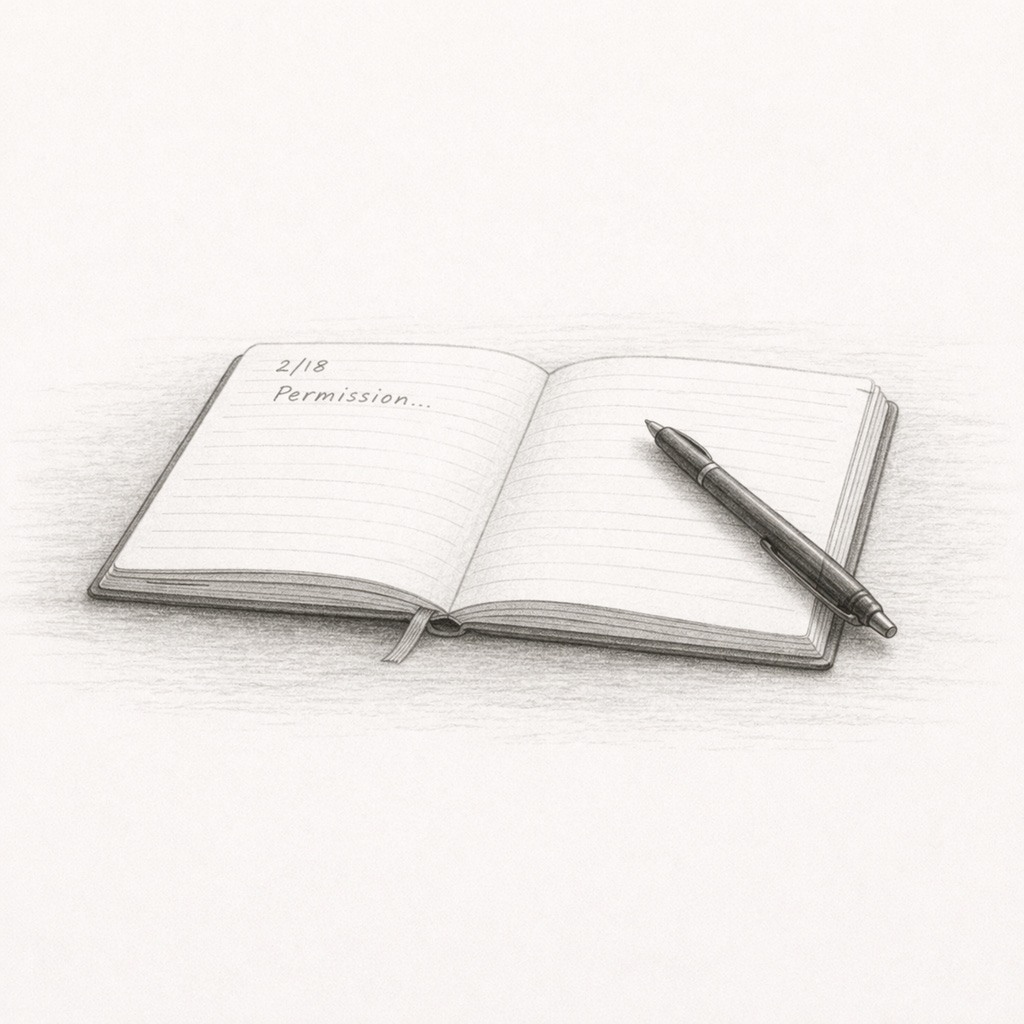
For ten years, I didn’t write publicly.
I found other things to do. Groceries to buy. Meals to make. Laundry to clean. Crumbs to sweep. Walks to take. Other people’s books to read.
But the desire never left. It followed me everywhere.
So did fear. It liked asking questions that undermined what I wanted:
Is my writing good enough?
Are the ideas I have interesting?
Is my voice distinct?
And always the sharpest one:
What could I possibly know that’s worth saying?
I filled countless notebooks, never thinking what I wrote was distinct or special. Thoughts sparked by books I’d read, small ideas, questions — they seemed far too ordinary for anyone else’s interest.
I kept asking: What do I know? Fully formed understanding felt necessary before I could begin.
Then I came across an idea:
A river isn’t special.
As soon as I saw it, I recognized my mistake. It was obvious — so obvious I laughed.
A river doesn’t seek permission to flow. It moves because it is conditions.
I had made a category error.
I had placed writing in the solid category of performance — and performance requires permission. But writing doesn’t belong there. It belongs in the category of movement.
The moment that landed in my body, I could breathe. My shoulders softened. My head cleared. Ten years of pressure released.
Fear revealed itself as distortion.
The gravitational center of writing — what I had been pressurizing as author, controller of words, performer — dropped. I could move.
It wasn’t confidence. It was re-situation.
Then it clicked: I had already known this.
I’ve seen how words come when I write. I don’t generate them. They arrive.
When I’m in a notebook, I don’t know the next sentence — sometimes not even the next word — until I write the one in front of me. Words don’t come by permission. They move when allowed.
A bird calling outside my window.
The way light shifts across my desk.
The feeling of coordination in my body while making a meal.
Words, notebook, and desire are to writing what gravity, volume, and sediment are to rivers.
Writing isn’t an act of understanding. It’s observation and documentation of conditions in word form.
When they move, they take shape.
And if there is an “I” in it at all, its only claim is responsible participant. Another condition.
Now I write.
—
If you’d like to read as new pieces arrive, you can subscribe.
Related Reading
If this piece resonated, you might also like:
• The Chisel and the Level — Two pages in, the “I” disappeared.
• The Horizon Keeps Rearranging — We never quite reach the horizon.
• A Loop About A Loop — A question interrupts.
Intentional self-creation. Beautiful